

Organizational Development
Build an Organization Designed to Perform.
Align structures, roles, governance, and ways of working so people can make better decisions, collaborate effectively, and execute with clarity.
Human Edge helps organizations translate strategy into the structures, accountabilities, and operating practices required to deliver it—creating greater clarity, stronger alignment, and more effective execution.
The Challenge
Strategy Breaks Down When the Organization Gets in the Way.
Organizations evolve. Strategies change. Businesses grow. New technologies are introduced. Responsibilities shift. Yet structures, roles, decision rights, and ways of working often fail to evolve at the same pace.
The result is familiar: unclear accountability, duplicated work, slow decisions, competing priorities, organizational friction, and leaders spending too much time navigating the organization instead of leading it.
Human Edge helps close the gap between how the organization is designed and how work actually gets done.
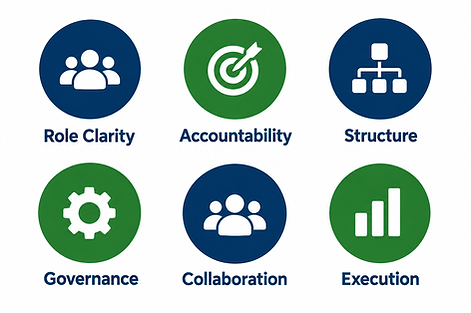
What We Develop
The Organizational Conditions for Better Performance
We work with leadership teams to design and strengthen the structures, systems, and practices that enable people to do their best work.
Ways of Working
Improve how teams coordinate, communicate, escalate issues, solve problems, and execute work across organizational boundaries.
Leadership Alignment
Create shared understanding among leaders around priorities, expectations, behaviors, and how the organization will operate.
Performance Systems
Align goals, measures, routines, feedback, and accountability mechanisms with desired organizational performance.
Organizational Structure
Align organizational structures, reporting relationships, spans of control, and interfaces with strategy and operational requirements.
Roles & Accountabilities
Define clear responsibilities, decision rights, interfaces, and expectations so people understand what they own and how their work connects.
Governance & Decision-Making
Establish practical governance structures that clarify authority, accelerate decisions, and strengthen accountability.

ORGANIZATIONAL FRICTION
The Symptoms Are Usually Easy to See.
These issues slow progress, create risk, and make the organization harder to lead.
Slow
Decisions
Unclear
Ownership
Functional
Silos
Competing
Priorities
Leadership Dependence
Execution
Gaps
The challenge is determining why these conditions exist, and redesigning the organization so they don't persist.
Organizational Design
Connect Strategy to How Work is Done.
Effective organization design creates a clear line of site from enterprise strategy to everyday decisions and actions.

Organizational Design Outputs
Practical Solutions Leaders Can Put to Work.

Organizational Design
Recommend structures, interfaces, reporting relationships, and spans of control
Implementation Roadmap
Sequenced actions, ownership, milestones, measures, and change requirements.
Governance Frameworks
Decision forums, escalation paths, authorities, and governance routines.
Ways-of-Working Model
Defined practices for collaboration, communication, coordination, and execution.
Leadership Alignment
Facilitated alignment around organizational expectations, priorities, and leadership responsibilities.
Implementation Roadmap
Sequenced actions, ownership, milestones, measures, and change requirements.
From Design to Impact
Changing The Structure Isn't Enough
Real results come from turning design into sustained action.

Diagnose
Understand organizational barriers and root causes.

Align
Build leadership agreement around the organization required.

Design
Develop structures, roles, governance, and ways of working.

Embed
Translate the design into everyday organizational practice.

Sustain Measure effectiveness and adapt as the organization evolves.

Let's Talk
Make the Organization Easier to Lead, and Easier to Work In.
If unclear roles, organizational silos, slow decisions, or competing priorities are getting in the way of performance, changing individual behavior alone won't solve the problem.
Human Edge helps organizations address the systems around people, creating the clarity, alignment, and operating conditions they need to perform.